
TFL LASER >(Thulium Fiber Laser) is a next-generation laser technology designed for the treatment of urinary stone disease and selected soft tissue procedures in urology. Over the past few years, TFL has gained widespread clinical acceptance due to its ability to deliver high-frequency, low-pulse-energy laser emissions, enabling efficient stone fragmentation with improved control during endourological procedures.
Unlike conventional Holmium laser systems, TFL uses a thulium-doped fiber as the active laser medium and operates at a wavelength of approximately 1,940 nm, which is strongly absorbed by water. This high water absorption allows laser energy to be transferred efficiently to the target, making TFL particularly effective for stone dusting while minimizing retropulsion.
How Does TFL Laser Work?
The TFL system generates laser energy through a thulium-doped optical fiber that is excited by diode lasers. The emitted energy is transmitted through small-diameter laser fibers directly to the urinary stone under endoscopic guidance.
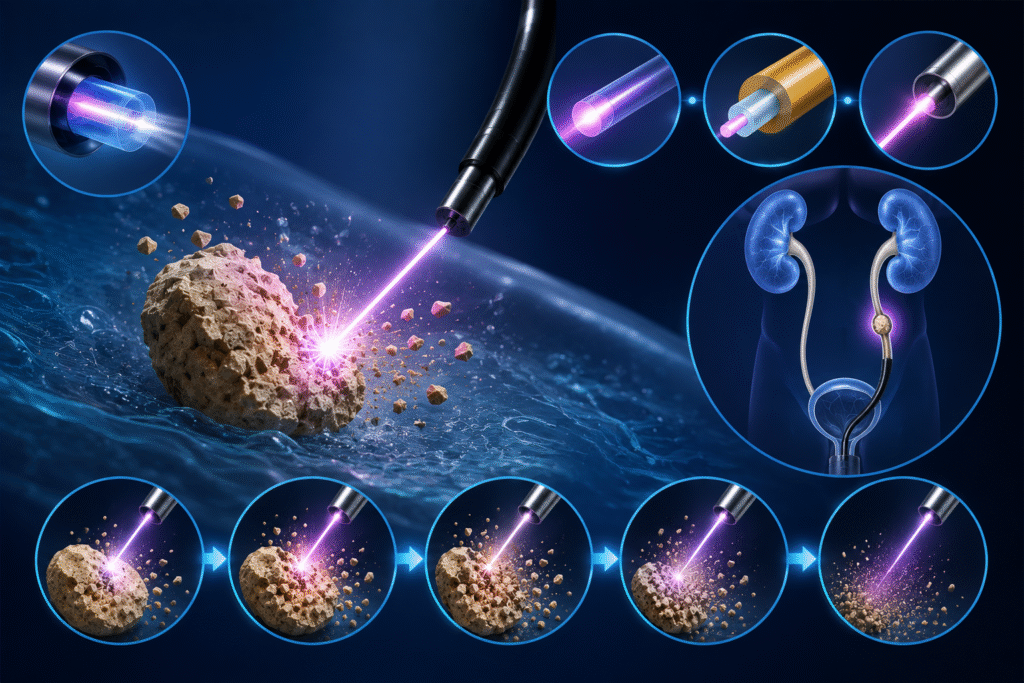
Because the laser wavelength closely matches the absorption peak of water, energy is rapidly absorbed at the stone surface, resulting in precise fragmentation with minimal energy loss.
The technology supports a broad range of pulse energies and frequencies, allowing surgeons to tailor treatment according to stone composition, size, and procedural objectives.
Why Has TFL Become Popular in Modern Urology?
TFL has become increasingly popular because it offers flexibility across different lithotripsy techniques. Whether the objective is fine dusting or controlled fragmentation, surgeons can adjust laser settings to suit individual clinical situations.
Key clinical advantages include:
- Efficient stone dusting with fine particle generation
- Reduced stone retropulsion during lithotripsy
- Compatibility with very small laser fibers
- Stable energy delivery across various settings
- Enhanced visibility during endoscopic procedures
- Suitable for flexible and semi-rigid ureteroscopy as well as mini-PCNL procedures
Clinical Applications of TFL
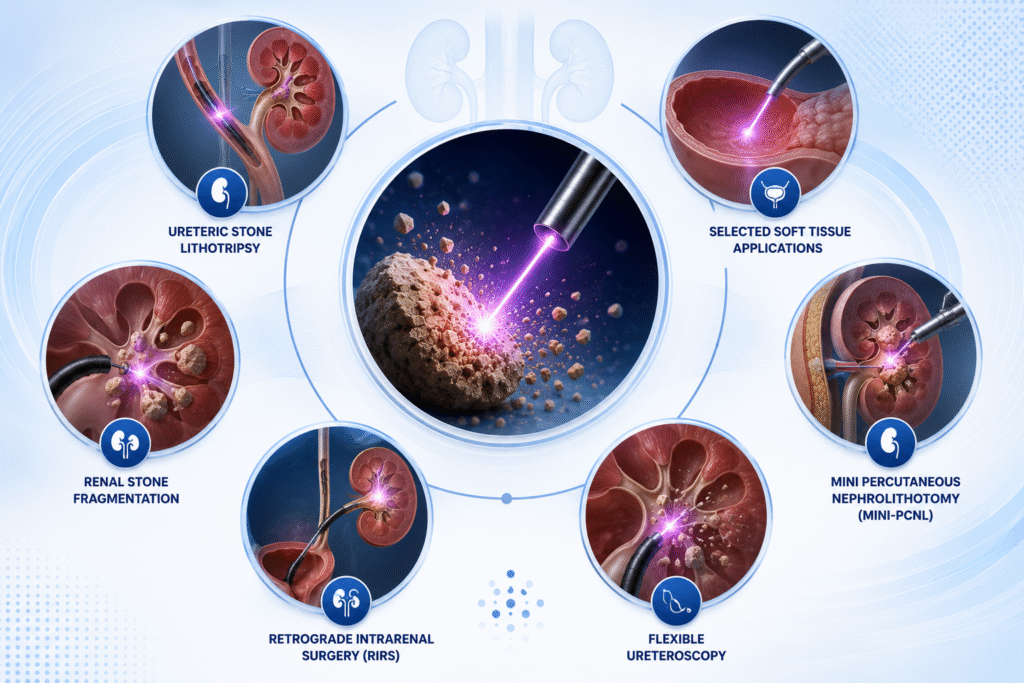
Thulium Fiber Laser is widely used for:
- Ureteric stone lithotripsy
- Renal stone fragmentation
- Retrograde Intrarenal Surgery (RIRS)
- Flexible ureteroscopy
- Mini Percutaneous Nephrolithotomy (Mini-PCNL)
- Selected soft tissue applications depending on system configuration
Its versatility allows clinicians to manage stones of varying sizes and locations while maintaining procedural efficiency.
Technology Highlights
Modern TFL platforms typically offer:
- Adjustable pulse energy
- High pulse frequency
- Fine dusting capability
- Low retropulsion characteristics
- Small-diameter laser fibers
- Digital user interface with customizable treatment presets
These features enable greater procedural flexibility and can contribute to smoother endoscopic stone management.
Why Are Smaller Laser Fibers Important?
One of the notable advantages of TFL technology is its compatibility with smaller laser fibers.
Smaller fibers may help:
- Improve irrigation flow
- Enhance endoscopic visibility
- Increase instrument flexibility
- Facilitate access to difficult calyces during RIRS
- Reduce resistance within the working channel of flexible ureteroscopes
These characteristics may improve procedural ergonomics in selected clinical scenarios.
TFL in Stone Dusting
Stone dusting has become an increasingly preferred approach for many endourological procedures.
TFL is particularly suited for dusting because it can deliver:
- Low pulse energy
- High pulse frequency
- Continuous stone ablation
- Fine stone particles
- Reduced need for basket extraction in selected cases
The choice of laser settings should always depend on stone characteristics and surgeon preference.
Safety Considerations
As with any laser technology, successful outcomes depend on:
- Appropriate patient selection
- Correct laser parameter selection
- Adequate irrigation
- Proper fiber handling
- Surgeon experience
- Compliance with established laser safety protocols
Following standard clinical guidelines remains essential for achieving optimal outcomes.
Conclusion
Thulium Fiber Laser represents a significant advancement in laser lithotripsy technology. Its unique wavelength, efficient energy delivery, compatibility with smaller laser fibers, and versatility across multiple endourological procedures have made it an increasingly valuable option in modern urological practice.
While individual treatment strategies should always be based on clinical judgment and patient-specific factors, TFL provides urologists with a powerful platform for effective stone management and procedural flexibility.
As technology continues to evolve, Thulium Fiber Laser is expected to play an increasingly important role in minimally invasive urology by supporting precision, efficiency, and improved surgical workflow.